Blog

Do you need to add water to a compost bin?

QUESTION: Do you need to add water to a compost bin?

ANSWER: It’s possible that you’ll need to occasionally add water to your compost bin to keep the microbes working at optimum capacity. Without the appropriate level of moisture, the microbes that decompose your compost materials won’t be able to do their job, and the process of decay that compost relies on will slow down to a crawl. This can happen, for example, if you’ve recently added a lot of dry carbon-rich ingredients, such as a big batch of dried leaves. 

“Green” or nitrogen rich materials typically have a lot of moisture, and that is the best way to keep your compost at the correct level of moisture. If you have the right balance of wet, nitrogen rich materials like kitchen scraps and fresh cut grass clippings. (Too much of this material will cause the opposite problem where your compost is too wet, and can then turn everything stinky.)

The compost materials should be kept moist enough to have the same dampness as a sponge that has been wrung out. If you aren’t sure whether your compost is moist enough, find some dried leaves in the pile and squeeze them tightly in your fist. The leaves should feel damp, and when you squeeze them tight, only one or two drops of water should trickle out. (Please take note that this “squeeze test” only works on dried leaves and should not be used on other compost ingredients to determine moisture level.)

The wrung-out sponge rule of thumb is all you really need to know to keep your compost moist enough. However, if you want to get technical about it, your compost ingredients should ideally be between 40 and 60 percent water, according to the Cornell Cooperative Extension.

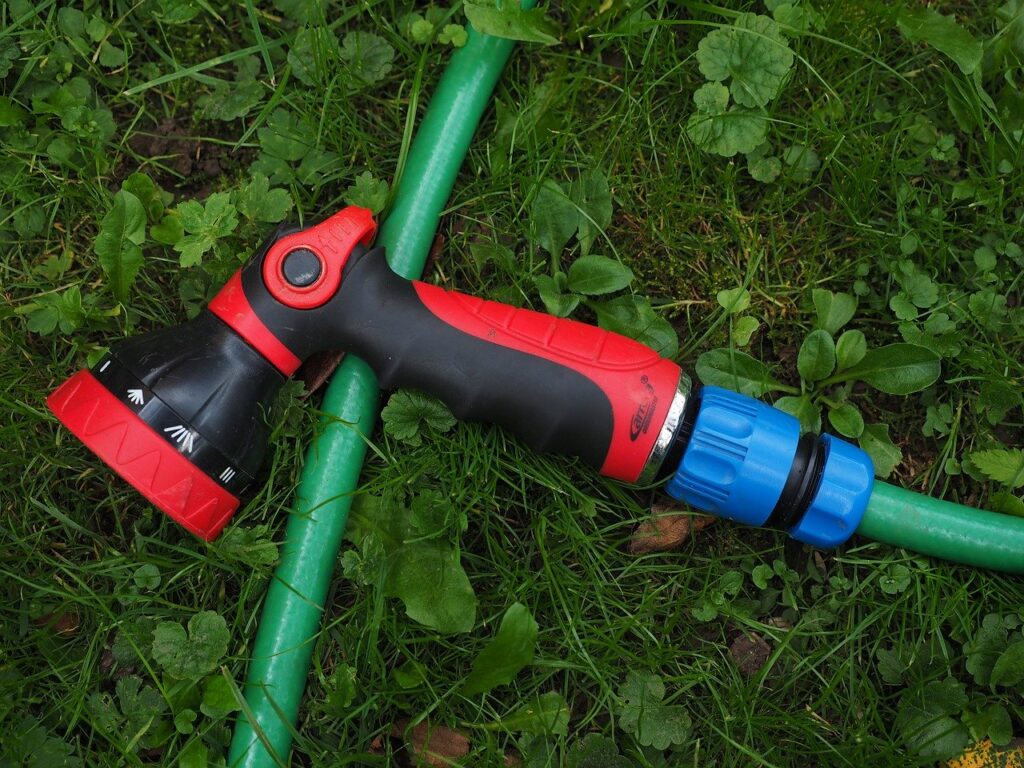
Whenever your compost dips below the moisture level of a wrung-out sponge, simply sprinkle some water on the pile with your garden hose for a couple of minutes. If you’d like, you can make things even easier for yourself by setting your sprinkler system near enough to your compost bin that some of the water lands on your compost whenever you need to add some moisture. You can also help balance out compost that’s too dry by adding in more wet materials, such as coffee grounds, vegetable scraps, or fresh grass clippings.

Sometimes, the problem will be reversed, and your compost will need to dry off a bit. It’s inevitable that you’ll sometimes overshoot the desired level of moisture when watering, and the compost can get too wet if you’ve added lots of wet ingredients lately, too. Compost that is too wet won’t be getting the oxygen it needs because the spaces between things where air should be circulating is instead filled with water. 

When this happens, just prop the lid of your compost bin open on a warm, sunny day, and leave the lid off so the sun’s rays can dry your compost materials out until your compost is back to the moisture level of a wrung-out sponge. (If it rains while you’re letting your compost soak up some sun, make sure to close the lid during the rainy spell.)

Alternatively, you can stir in some more dry, carbon-heavy ingredients like dried grass clippings, wood chips, dried leaves, shredded newspaper, or shredded cardboard to help balance the excess moisture out and get the hydration level back where you want it. When you’re adding ingredients to dry things out a bit, you want to choose the coarsest, most porous dry materials you have available because the added permeability will allow air to circulate and dry the compost off as well as giving the excess water space to drain out.

Where should you NOT put a compost bin?

QUESTION: Where should you NOT put a compost bin? It would be messy to move it once we start filling it up, so I want to put it in the right spot the first time. – Jack K

ANSWER: Short answer. Anywhere is fine, but try not to put it too close to your door or any windows you open, in case you do something wrong that causes bad smells or insects and pests.

Placing your compost bin in direct sunlight won’t actually help the heating process along, and direct sunlight can make working with the bin less comfortable for you during the heat of the summer if you live in a hot region.

In a warm climate, direct sunlight on your compost heap will also cause the water that’s keeping it moist to evaporate. For those reasons, if your weather stays warm, it’s best to position your compost pile in the shade. However, avoid placing it too near a tree, or the tree’s roots can grow up through the bottom of the compost in search of nutrients. 

If you live somewhere with cooler temperatures and more rainfall, moisture loss won’t be a concern for you, and the rain will probably introduce more moisture than your compost needs. That’s why if you live in a cold, wet region, you’ll want to select a sunny location. Some windbreaks near your compost pile can also help keep the moisture in it that wind would otherwise cause to evaporate.

Shade is especially important for those using the vermicomposting method, as too much sunlight can be a death sentence for worms. Worms should be protected from rainfall as well, or they can drown. Vermicomposters often keep their bins indoors, in a garage, a closet, or under a counter.

You’ll also want your compost pile to be located on top of dirt as opposed to concrete if possible—unless you’re using a closed container, in which case it won’t matter. Beneficial insects are able to climb right into compost piles that have a dirt bottom, and they’ll help the decomposition process along, making your compost system more efficient. If you place your compost on dirt, you should use wire mesh or hardware cloth as a base to keep out rodents and other animals. Another reason not to set your compost heap up on concrete is that the concrete will inevitably be stained where the compost has touched it.

Because watering your compost will be easier if you’re able to use your garden hose, you should set the pile up somewhere that the hose can stretch to if possible. Otherwise, you’ll have to lug containers of water back and forth to the pile whenever you need to add water.

Similarly, you’ll want your compost to be situated near to your garden so it’s easy to access. However, you may wish to put some distance between your compost and your home in case you have trouble with pests or smells (although these should not be an issue when the compost is properly managed). For similar reasons, you should avoid placing your compost setup too near to a neighbor’s property.

If you set your compost up in a spot that has twice as much room as your system will take up, it will make turning the pile much easier. You’ll be able to easily turn the pile over and rebuild it right next to its previous location. However, if you’ll be using passive composting and won’t be turning the compost as often, that amount of extra space won’t be a concern for you. Passive  composters just need to leave enough room around the bin to make it easy to access from all sides.

Do eggshells in compost attract rats?

QUESTION: Do eggshells in compost attract rats? Should I put them in the disposal or throw them away, or can I compost them? Mark M

ANSWER: It usually isn’t a great idea to put eggshells into your compost, as they take a very long time to decompose. More importantly, eggshells do attract rats. Eggshells, especially if they are not rinsed, have egg residue on them, which dries and can smell. The smell of eggs is a sure fire way to invite rats to your compost bin as if you were throwing a party specifically for rodents to attend. 

Aside from eggshells, avoid adding any cooked meat or fish products, or anything that is particularly strong-smelling like cheese and fats to your compost bin. Eggshells seem to be a personal favorite for rodents though, so be sure to keep them out of your compost, and if you’re going to use them in the garden for any reason, such as to deter slugs and snails, be sure to wash them well first, removing any trace of egg residue. 

Other than strong smells, rats may be attracted to your compost bin for several reasons. Because you use your composting system to discard kitchen scraps, it provides a food source. Properly functioning compost piles are also a good heat source. If it’s cold outside in your area, rats may be attracted to your compost pile because of its warmth Compost bins are usually kept in dark, tucked away locations, just the type of spots where rats are known to dwell.  

Luckily, there are a few simple preventative tactics that you can implore to rat-proof your compost bin and keep rats away from your compost, and your garden area in general, aside from throwing your eggshells in the trash instead of the compost. First, use a solid-sided container as your compost bin. If you are using a wooden, open-slatted bin for composting, only use it for garden waste and keep your kitchen scraps and vegetable peelings in a closed bin with solid sides and a well-fitting lid. 

Most plastic commercial compost bins are made to be rat-proof, with a thick rat-proof base. However, if yours doesn’t have a rat-proof bottom, place it on wire mesh. Rats can surprisingly squeeze through gaps that are just over half an inch (or 15 mm), so the holes in your wire mesh need to be smaller than that, and made out of a heavy-duty material. Rats have super sharp teeth and can gnaw right through chicken wire in no time. Use a galvanized light welded wire mesh that is at least a half an inch by a half an inch thick so that rodents can’t chew right through it. 

Set the bin up squarely to ensure that there is no gap between the sides and the lid to make it harder for a rat to chew a new entryway into your bin. If they can find an edge to chew on, they will eat through the plastic until they have made themselves an easy entry/exit hole in your compost bin. Rats don’t like to be out in the open, but rather prefer to stick to the sides and edges where they have some security and a protected passage to scurry across. So, if possible, place your compost bin or pile right out in the open, as far away from fences, sheds, and structures as possible to discourage them by giving them no place to hide near your compost. 

Rats also hate loud noises and surprises. So place your compost bin in a location that you pass by regularly and use a stick to whack the side of the bin loudly every time you pass it by. This will make them think twice about setting up home base in your compost heap. Survey your garden to locate places where rodents can easily hide, such as tall grass, or wildflower meadows. While ornamental grasses and wildflowers may look nice in your garden, they can be a hotbed for rodents too. Make sure your compost bin is far away from any places where rats can easily hide in the grass. 

Birds are messy eaters and can easily leave enough seed on the ground to keep a few rodents well fed. If you have a birdfeeder, consider placing a slab of pavement or some sort of flat surface beneath it so that you can easily sweep up fallen seeds that your neighborhood birds leave behind. You may prefer that the rats eat spilt seeds to feast on your garden’s goods, but the ultimate goal is to drive the rats off your property completely, so leave no stone unturned when rat-proofing your property. 

If you carry out several of these rat-proofing measures and are still having troubles with rats, you may have no choice but to invest in a heavy-duty tumbler composting system, or even to hire a pest control company to come out and lay out traps or poison. However, in most cases, just a few rat-proofing tactics will send them in search of a more comfortable habitat. Once you have taken all the necessary steps to rat-proof your garden, compost bins, and property, with any luck, the rats in your area will most likely move on to less hostile environments.

Can I put old compost in my green bin?

QUESTION: Can I put old compost in my green bin? It’s just sitting in a finished pile and I haven’t had a garden in several seasons. – Mark M

ANSWER: If your city uses a three-bin system with a green bin for yard waste and food waste, it’s probably not recommended to put old compost into your green bin. Although old compost is biodegradable and organic like the other things you place in your green bin, after doing some research we noticed that several cities had listed dirt on their list of substances not to include in green bins, and finished compost is, at its core, dirt—though it is more rich in nutrients than most dirt you would find in nature.

Of course, you always have the option of contacting your city’s waste removal department to ask them about the local guidelines, as regulations vary from one city to another.

Instead, why don’t your spread it on your lawn? Compost enriches your soil, and it will generally disappear from the surface within a few days if you spread it on the grass — especially if you water it in.

Can I put old potting soil in my compost?

QUESTION: Can I put old potting soil in my compost? I found several bags in my garden shed. Ted K

ANSWER: Old potting soil makes a great addition to your compost if you take just a few precautions. Soil that’s already been used can harbor pathogens that carry plant disease and could infect next season’s plants when you use the compost in your garden.

These pathogens may include viruses, fungi, bacteria, nematodes, and more. We know that introducing disease to your garden when you’re trying to make it more healthy is the last thing you want to happen, so just follow the steps below to make sure the pathogens are rendered risk-free in your compost.

First things first: You should never add potting soil where a diseased plant has been growing to the compost pile in an attempt to recycle it. (The same goes for diseased plant debris, by the way.) You know the soil where a diseased plant has been housed is bound to carry disease, and we want to minimize the risk of passing that disease along in the future. Instead, discard this soil in the trash so it can’t infect any of your plants. 

By pasteurizing your old potting soil, you can deactivate any pathogens it may contain and, at the same time, kill the seeds of any invasive plants that may be sprinkled throughout it. (Yes, pasteurizing soil is something you can do at home on your own!) To start, just load any potting soil you wish to reuse in your compost into black plastic garbage bags. (Make sure when you’re gathering supplies that you choose black bags, which will soak up more heat than other bags and pass that heat along to the soil inside.) Then move the bags to the sunniest spot in your yard so they can bake in the sun.

Leave the bags in their sunny spot for at least a week. This replicates the pasteurization that occurs in your compost pile as it heats up in a much shorter time period and makes the potting soil safe to add to your compost so you won’t have to worry about contaminating the mixture.