What will make compost break down faster?

QUESTION: What will make compost break down faster? My compost pile doesn’t seem to be doing anything after several months. – Rita M

ANSWER: There are several things you can do to speed nature’s work decomposing your compost along so that you can put the nutrient-rich final product  to use in your garden more quickly. We’ll go over each of them step by step here so you can put one two of your favorites—or all of them—into practice and accelerate the process.

Maintain the proper balance of materials

The proper ratio of carbon-rich and nitrogen-rich ingredients for the compost heap is 30 parts brown for every one part green. When this equation is out of balance, your compost pile may fail to heat up, and you’ll notice the decomposition process moving more slowly than it does when the makeup of the compost is accurately regulated.

Some gardeners get really precise with their management of the proper balance, weighing everything they add to their compost and calculating the ratio using complex mathematical equations [http://compost.css.cornell.edu/calc/cn_ratio.html]. If this sounds like fun to you, then by all means have at it, but you don’t have to enforce the guideline quite so rigorously to still keep things relatively in proportion and have success. 

The easiest way to approximate the ratio without doing a lot of algebra homework is to make sure when you’re adding ingredients to your compost that the brown and green components are equal in weight. To reiterate, using this method, you compare the weight of each type of ingredient, not the size or volume. For example, a carbon-heavy substance like shredded paper or leaves collected in raking may be like a giant pile but not weigh nearly as much as the kitchen scraps you’re including as your green element.

You don’t even need to make sure the weight of your ingredient types is equivalent each time you add things to your compost. As long as the sources of carbon and nitrogen you throw into the pile are approximately even in weight over about a  week-long period, your compost should stay running on all cylinders. When the materials you include are kept in proper balance, they should break down fairly quickly—and as a bonus, a properly managed compost heap will do its work without creating any unpleasant smells.

If you haven’t kept an eye on maintaining a harmonious balance of materials and you notice that your compost is decomposing more slowly because of it, there is a simple solution. You can use a product called a compost “starter” (also referred to as a compost “activator” or compost “acceleration”) to help get things back into gear.

Compost starters are commercial products made of either nitrogen-rich materials that will help your compost heap start warming up again or an infusion of microbes to pitch in and start breaking down the components of your compost. Choose the nitrogen type of compost starter if your own compost consists mostly of carbon-heavy elements, like paper or dried leaves. Choose the microbe type of compost accelerator if you’ve already included plenty of nitrogen in your own compost heap, as going overboard with nitrogen can actually slow down the decomposition of your compost. 

As an alternative, if the process seems to be dragging and you don’t want to use a compost starter, you can always give things a little push by adding some water to your compost, along with an infusion of nitrogen-heavy “green” ingredients. If you’re too heavy handed when adding water and get the compost too wet, you may notice the materials becoming a little slimy or smelly. Should this happen, just leave the lid off your composting container so the sun can dry things out a bit. If things are still too damp, you can take them out of the container and spread them out for even more drying from the sun. You should also mix in a batch of some dry, carbon-heavy “brown” materials, like dried leaves.

Aerate the compost so oxygen can circulate.

When you stir and turn your compost on a regular basis, you’re making sure the microbes that break everything down get plenty of oxygen so they’re able to breathe, and therefore survive. It is possible to turn your compost too frequently, which will have the opposite of the desired effect and slow the process down, so don’t start stirring the compost daily or even every couple of days. The sweet spot as far as timing is concerned is turning your compost every few weeks.  

There are specialized tools on the market that you can use, such as handheld compost turners or tumbling compost containers that will do the work of turning for you. Although you can certainly use these if you would like, it’s usually not necessary to go out and purchase a specialized tool for mixing your compost. Most gardeners will already have something in the shed that they can use to turn their compost, such as a pitchfork or shovel. If your compost bin has no bottom and is light enough for you to lift, you can simply lift it and place it next to the compost pile, then replace the materials inside, to aerate and mix the ingredients.

If you prefer a more hands-off approach to composting or all this sounds like a lot of extra work, bear in mind that turning the compost regularly is not required in order to have a quality finished product. Your compost will still break down to produce the nutrient-rich “black gold of the garden” you’re looking for, even if you don’t turn it. The process will just happen more quickly if you take the time to aerate your compost every couple of weeks.

Keep moisture at the appropriate level

Much like the carbon-nitrogen ingredient ratio, the level of water in your compost heap also needs to be kept in balance in order for the process to run as smoothly as possible so your compost pile works efficiently and quickly. By providing the appropriate amount of moisture, you’re cultivating the health of the microbes that do the work of breaking everything down. The consistency you should be shooting for is when your compost materials have the moisture level of a sponge that has been wrung out.

To hydrate your compost, the simplest way is to use the garden hose, if it can stretch to wherever your pile is set up. Just take a few minutes to sprinkle the water over the surface of your compost heap using the hose.You can automate this process if you’d like by setting your sprinklers near enough to your compost bin that the water reaches the materials inside. (Make sure to open the lid of your composting container before each sprinkler session, or the session will be pointless.)

On the other side of the coin, if your compost has more dampness than a wrung-out sponge, you’ll need to dry things out a bit. You can start by propping open the lid of your composting container on a warm, sunny day so the sun’s rays can help dry the ingredients out. If that doesn’t do the trick, remove the materials from the bin and spread them across the ground so it’s easier for the sunlight to reach all of them. Also, add in some more carbon-heavy ingredients that are dry enough to soak up some of the excess moisture, like dried leaves or, if leaves aren’t available, some shredded paper or cardboard.

Can roses go in compost?

QUESTION: Can roses go in compost? Someone sent me a dozen, and I hate to throw them away, even though they’re now spent. – Dara M

ANSWER: Not all parts of the rose plant are appropriate for composting, but you can add the flowers, soft green stems, and leaves of rose bushes to your compost bin, with a few exceptions. Parts of the rosebush other than stems make a good compost ingredient whether the roses came from your garden or the florist.

Fresh flowers function as a “green” component to provide your compost with nitrogen, and dried flowers are a source of carbon and serve as a “brown” compost material. The twigs and soft green branches of the rosebush will create some space around them in the compost heap, aerating it so that oxygen can circulate, which keeps the decomposition process moving along by making oxygen available to microbes.

The thorny stems of rose plants take a terribly long time to break down, so unfortunately they should not be added to compost. You should never add diseased plants to the compost heap, roses included, or you risk passing the disease along to next season’s plants when the compost is put to work in your garden. In a similar vein, you should not include debris from any plants that have come into contact with chemical treatments, whether they are roses or other varieties.  

Make sure to cut the stems and leaves into pieces so that they break down quickly and easily, and separate the petals of rose blossoms as you add them to the compost heap. Even the roots of rose bushes can be added to the compost pile, so at the end of the season, you can pull up the roots of annual rose bushes. Perennial types should be left in the ground where they are so they can return to bloom again next season.

Can I use shredded paper in compost?

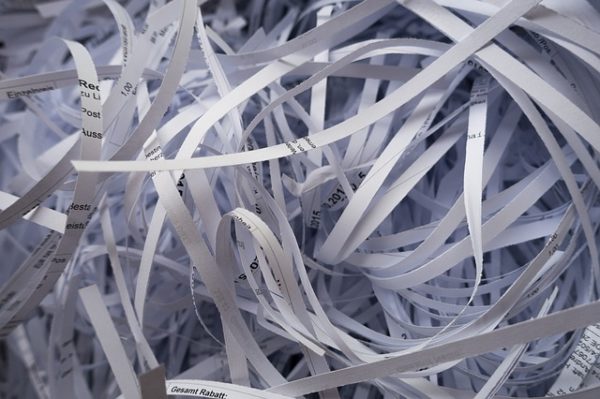
shredded paper for composting

QUESTION: Can I use shredded paper in compost? We run paper through our paper shredder, and I’m currently throwing it away. – Donny E

ANSWER: It’s debated whether certain types of paper are safe for inclusion in compost, and we’ve listed them for you at the end of this section. Most of the time, though, shredded paper is one of the standby materials that go into compost, and it counts as a “brown” Ingredient, or one that provides carbon for your compost.

All weights of paper, from newsprint to cardboard, will work and are permissible as an ingredient in composting. Recommendations against using printed paper are outdated, as modern inks are made of soybeans and carbon. It is important for you to shred any paper materials you’ll be adding to your compost so that they break down more quickly and easily.

Paper is a valuable material for composting because it’s a great source of carbon.Shredded paper also helps soil to retain water and increases its volume. Vermicomposters especially love paper because worms enthusiastically eat it and even take shelter in it, searching it out above other materials in the compost bin. 

In the compost pile, shredded paper can have a tendency to clump and mat together. This inhibits the movement of oxygen through the compost and can be detrimental to the microbes we depend on to break down the elements that make up our compost. To prevent this from happening, mix shredded paper with a looser substance, like grass clippings or dried leaves, before you add it to the compost heap. 

As an alternative, you can take advantage of shredded paper’s tendency to clump and mat by using it as a mulch instead of including it in compost. Spread shredded paper on top of your plant beds or around trees, giving plant stems and tree trunks a bit of space between them and the paper. Then moisten the paper with a sprinkler or water from the garden hose, and sprinkle some pine straw across the top. The shredded paper mulch will end up resembling a sheet of papier-mâché, and it will do a great job of helping the soil underneath it retain moisture as well as preventing weeds from sprouting up through the mulch layer.

Colored paper and glossy paper can be made up of toxic heavy metals that you don’t want to pass along to your plants, so don’t include colored or glossy papers when you’re adding to your compost. Another exception is paper that has come into contact with pet waste, as animal waste can carry pathogens and should never be included. That said, paper that has been used to line a bird cage is OK for composting and is a source of both carbon and nitrogen.

The types of paper listed here are safe for composting.

  • Bills
  • Envelopes
  • Junk mail (as long as it does not include glossy paper)
  • Memo paper and scrap paper
  • Newspapers or any type of newsprint
  • Notebook paper
  • Personal letters
  • Printer paper from the home and office printer or copy machine, whether or not it has been printed on
  • Receipts

This is by no means a comprehensive list of all the various types of paper that are safe to use in composting, simply because there are so many different kinds of paper out there to use. You’ll probably end up composting paper from sources not included on the list. 

Although many people compost all types of paper and experience no issues, there are concerns that certain types of paper contain contaminants. We recommend doing your research to determine why the paper types listed below are causes for concern so you can make a well informed decision about whether or not to compost the kinds of paper listed here. Each person must assess the level of risk their compost materials carry and decide for themselves what they’re comfortable with. You should proceed with caution before composting the following types of paper.

  • Construction paper of any color
  • Foil and paper that has metallic foil printing
  • Fluorescent colors of paper and card stock
  • Glossy paper
  • Magazines or paper that comes from magazines
  • Metallic colored paper, or paper that has been printed with metallic ink
  • Wax paper (or paper that just has a waxy finish)

Can I use regular earthworms for composting?

earthworms for composting

QUESTION: Can I use regular earthworms for composting? And how do I do it? – Frances N

ANSWER: First of all, unless you’re using the vermicomposting method, you don’t need to worry about obtaining worms for your compost heap. A few worms are bound to wiggle in on their own, and they’ll come and go as they please, but you don’t need to supervise them or make sure your compost has worms in it. Invisible microbes in your compost will do the work of breaking its components down, so you don’t need to add worms in order to get things done.

However, if you are using vermicomposting and need to source some worms for your worm farm, earthworms are not your best bet. Most vermicomposters use red wigglers (Eisenia fetida) or redworms (Lumbricus rubellus), and with good reason. The compost pile heats up much more than everyday soil would because of the microbes at work breaking down its ingredients. A compost heap can get so hot that it will kill regular earthworms, but red wigglers and redworms do better in the compost’s hot conditions. (Red wigglers can tolerate temperatures that range from 32 to 95 degrees Fahrenheit.) 

Another important consideration is that standard earthworms don’t feed on food and paper waste or the other components that make up the compost pile. They actually get their nutrition by soaking it up through their skin, from the soil they move through or, if they’re rooting around in someone’s compost heap, from the substances in the compost. That means although earthworms will happily slink through your compost (as long as it isn’t too hot), they won’t be contributing to the process of decay that produces the final product.

Can Kleenex go in compost?

nose tissue for composting

QUESTION: Can Kleenex go in compost? Seems like a waste to throw them away or flush them. – Tracy F

ANSWER: Kleenex and other tissues, on their own, pose no problems in composting and function like paper as a carbon-rich “brown” ingredient. However, the heat level of the average compost heap is not high enough to kill the pathogens that Kleenex will contain after it’s been used to blow one’s nose or for other sanitary purposes. That means Kleenex that’s come into contact with bodily fluids, whether you’re sick or not, should not be used in composting if you are going to be touching the compost with your hands regularly, but probably ok otherwise. More importantly, you should avoid composting any tissues that have been used to clean up pet waste or oil, or tissues you’ve used in conjunction with cleaning products and other substances that contain chemicals

The exception when it comes to Kleenex that may contain germs is Bokashi composting, as the fermentation process it involves kills pathogens and puts an end to the risk of passing along disease. Because of the extra organic material, people who are using Bokashi composting to recycle Kleenex will just need to add a little more bokashi compost accelerator (also called bokashi bran) than usual to their kitchen composter.